- gegeben: $R_1 = R_2 = R_3 = 10 kΩ$
- gegeben: $U=15 V$
- gesucht: $I_3$
$R_{\mathrm{ges}} = R_1 + \frac{R_2 \cdot R_3}{R_2 + R_3} = 10 kΩ + \frac{10 kΩ \cdot 10 kΩ}{10 kΩ + 10 kΩ} = 15 kΩ$
$\frac{U_3}{U} = \frac{R_2 \parallel R_3}{R_{\mathrm{ges}}} \Rightarrow U_3 = \frac{R_2 \parallel R_3}{R_{\mathrm{ges}}} \cdot U = \frac{5 kΩ}{15 kΩ} \cdot 15 V = 5 V$
$I_3 = \frac{U_3}{R_3} = \frac{5 V}{10 kΩ} = 0,5 mA$
Lösungsweg
* gegeben: $R = \qtyrange{0}{1}{\kilo\ohm}$
* gegeben: $R_1 = 200 Ω$
* gegeben: $R_2 = 100 Ω$
* gegeben: $R_3 = 200 Ω$
$R_{\mathrm{ges}} = R_1 + \frac{R_2 \cdot (R_3 + R)}{R_2 + (R_3 + R)}$
Bei $R = 0 Ω$:
$R_{\mathrm{ges}} = 200 Ω + \frac{100 Ω \cdot (200 Ω + 0 Ω)}{100 Ω + 200 Ω + 0 Ω} \approx 267 Ω$
Bei $R = 1 kΩ$:
$R_{\mathrm{ges}} = 200 Ω + \frac{100 Ω \cdot (200 Ω + 1 kΩ)}{100 Ω + 200 Ω +1 kΩ} \approx 292 Ω$
Lösungsweg
- gegeben: $R_1 = 10 kΩ$
- gegeben: $R_2 = 2,2 kΩ$
- gegeben: $R_L = 8,2 kΩ$
- gegeben: $U_B = 12 V$
- gesucht: $U_2$
$\frac{U_2}{U_B} = \frac{R_2 \parallel R_L}{R_{\mathrm{ges}}}$
$R_2 \parallel R_L = \frac{R_2 \cdot R_L}{R_2 + R_L} = \frac{2,2 kΩ \cdot 8,2 kΩ}{2,2 kΩ + 8,2 kΩ} = 1,74 kΩ$
$R_{\mathrm{ges}} = R_1 + R_2 \parallel R_L = 10 kΩ + 1,74 kΩ = 11,74 kΩ$
$U_2 = \frac{R_2 \parallel R_L}{R_{\mathrm{ges}}} \cdot U_B = \frac{1,74 kΩ}{11,74 kΩ} \cdot 12 V \approx 1,8 V$

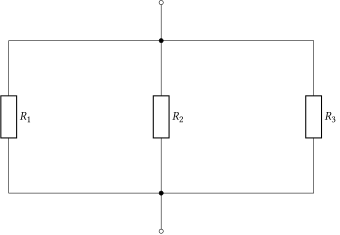
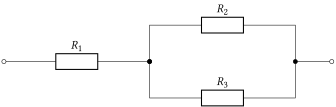 Hier berechnet man zuerst die Parallelschaltung von $R_2$ und $R_3$ und addiert dann $R_1$ hinzu.
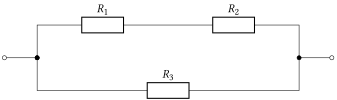 Hier addiert man zuerst $R_1$ und $R_2$ um mit diesem Ergebnis die Parallelschaltung zu $R_3$ zu berechnen.
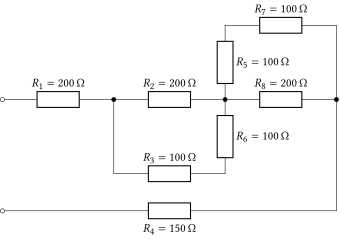
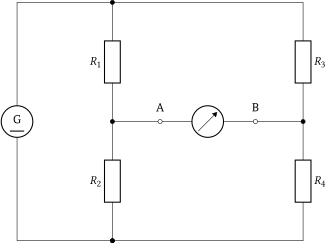 * Schaltung aus 4 Widerständen zur Widerstandsmessung
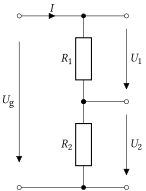
* Zwei parallel geschaltete Spannungsteiler
* Bei gleich großen Spannungsteilerverhältnissen fließt kein Strom über die Brücke
* Schaltung aus 4 Widerständen zur Widerstandsmessung
* Zwei parallel geschaltete Spannungsteiler
* Bei gleich großen Spannungsteilerverhältnissen fließt kein Strom über die Brücke
 * Die parallel geschalteten Kondensatoren wirken wie ein großer Kondensator
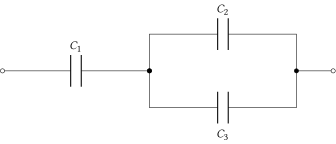
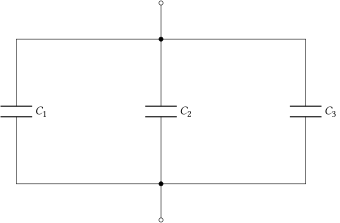 * Hier berechnet man zuerst die Parallelschaltung von $C_{2}$ und $C_{3}$
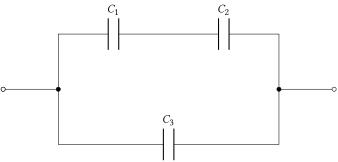
 * Hier berechnet man zuerst die Reihenschaltung von $C_{1}$ und $C_{2}$
 * Bei einer Spule in Reihenschaltung addieren sich die Induktivitäten
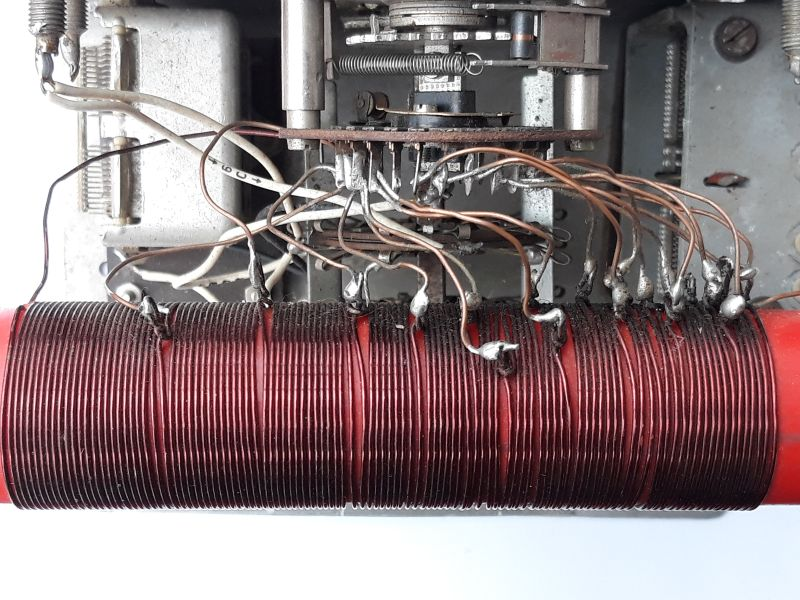
* Mehrere Spulen hintereinander $\rightarrow$ Wicklung wird verlängert
* Bei einer Spule in Reihenschaltung addieren sich die Induktivitäten
* Mehrere Spulen hintereinander $\rightarrow$ Wicklung wird verlängert